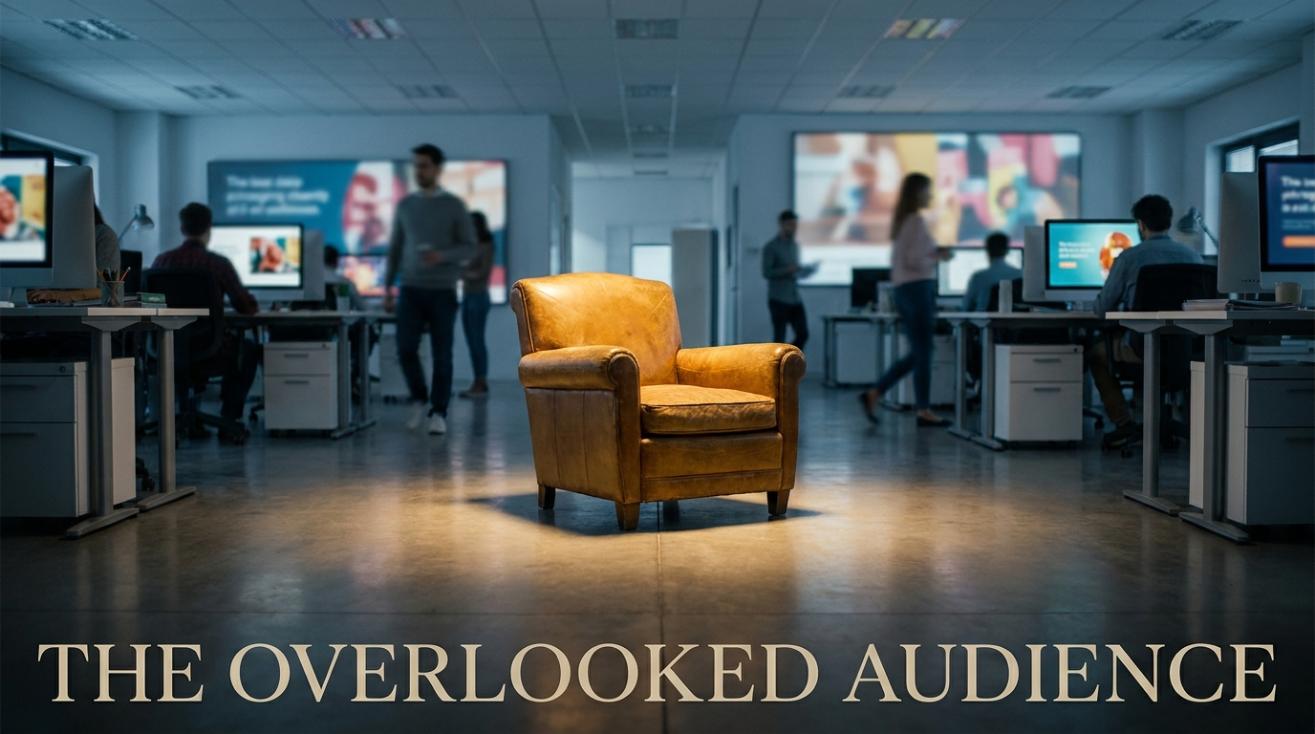
93% of Gen X Feels Ignored by Ads — Your Spy Data Can Show You Exactly Why
The $5 Trillion Blind Spot That Surveys Found but Can’t Fix

Ninety-three percent. That’s not a soft signal or a directional hint buried in a footnote — it’s a near-unanimous verdict. New research from Curion Insights reveals that 93% of Gen Xers feel brand messaging misses them entirely, and only 6.5% of consumers aged 50 and older believe the marketing aimed at them “feels authentically designed for people like them.” The study, which surveyed 7,000 Americans, paints a picture of a generation that isn’t quietly disengaged — it’s actively noticing that brands don’t care enough to get the message right.
What makes this statistic sting rather than merely surprise is the economic weight sitting behind it. Gen X accounts for roughly $5 trillion in U.S. consumer spending, and according to a World Economic Forum report cited by Adweek, they’ve been leading global consumer spending since 2021 and are projected to continue doing so through 2033. Close to half of adults 50 and older are the final household decision makers across nearly every major product category — clothing, household goods, food and beverages. These aren’t people winding down their purchasing lives. As Curion’s VP of strategic insights Maureen Moran Evans told Adweek, “The majority of fifty-somethings are still out and about, meeting for dinner or drinks, or buying clothes.” The problem, she explained, is a marketing industry that assumes “after a certain age, it’s not sexy anymore to think that we’re doing that.”
The reasons for this blind spot are structural. Evans pointed to an advertising workforce skewed dramatically young — only 12% of advertising professionals are between 55 and 65, while those aged 25 to 44 make up over half the industry. The result is a generation of media buyers and creatives building campaigns informed by their own instincts rather than their audience’s reality, producing ads fixated on reverse mortgages, hearing aids, and — Evans’ personal favorite — “a person with diabetes dancing around in a fountain.” As Curion’s report concluded: “The 50-plus consumer is not aging out of relevance. Brands are aging out of alignment.”
This is where the data becomes both invaluable and frustrating. The Curion study diagnoses the disease with clinical precision, but it offers no mechanism for a media buyer to act on it by Monday morning. Survey research is structurally backward-looking — it captures sentiment after the damage is done. As VideoWeek has reported, traditional brand-tracking surveys come loaded with respondents’ preconceived notions, and even asking whether someone has seen an ad draws unreliable responses because consumers are exposed to hundreds of ads every day. Surveys can tell you that Gen X feels ignored. They cannot tell you which specific headlines, hero images, calls to action, and landing page structures are being served to this demographic right now — the actual creative artifacts causing that feeling.
That gap between diagnosis and prescription is enormous. Knowing that 93% of a $5 trillion cohort feels unseen is a powerful rallying cry for a boardroom presentation, but it doesn’t help you rewrite a single Facebook ad or restructure a single campaign targeting parameter before your next budget cycle. The feeling is quantified. The creative causing that feeling is not. And until you can see the actual ads your competitors are running — the ones reinforcing every stereotype Evans described — you’re stuck treating symptoms without ever examining the pathology. That’s the gap where competitive ad intelligence enters, turning an industry-wide lament into an actionable, Monday-morning playbook.
Why the Creative Keeps Failing — The Industry’s Structural Empathy Deficit
The creative failure isn’t a mystery — it’s a staffing problem wearing a strategy hat. Only about 12% of advertising professionals fall between the ages of 55 and 65, which means the people crafting messages for the most affluent consumer generation in history are overwhelmingly not part of it. As one industry observer put it, many agencies are staffed with “kids right out of school” who default to the cultural references, visual language, and platform instincts they know — which skew unmistakably young. The result is a structural empathy deficit: teams building campaigns for a 52-year-old planning a kitchen renovation are operating from the same playbook they’d use for a 78-year-old considering a stairlift, because internally, both audiences get flattened into the same “older consumer” bucket.
This lazy demographic lumping produces two equally damaging creative outcomes. The first is patronizing: ads leaning on aging clichés, featuring seniors in rockers or pitching reverse mortgages to people who are fifteen years from retirement. The second is erasure: youth-coded creative — hyper-kinetic edits, TikTok-native aesthetics, influencer-led strategies anchored to creators in their twenties — that simply pretends Gen X doesn’t exist. Neither version reflects the actual lived reality of a generation currently in its peak earning and spending years, and both register as tone-deaf to the people they’re supposed to reach. When your creative team’s median age is closer to the intern pool than to the target audience, these blind spots aren’t bugs — they’re the default output.
Now layer in the AI-generated content problem, and the deficit compounds. Brands racing to scale creative production with generative AI tools are discovering a painful irony: the technology that promises hyper-personalization often delivers the opposite. According to Canva’s 2026 state of marketing and AI report, 70% of consumers say they can spot an AI-generated ad because it feels like it’s “missing its soul,” and 69% worry advertising is devolving into a sea of “AI-generated slop.” These aren’t fringe objections. Seventy-four percent of consumers say they’re more likely to buy from an ad they believe was created entirely by humans, a finding that should alarm any brand substituting volume for voice.
The issue isn’t that AI is inherently incapable of producing good creative. It’s that when young teams use AI to scale content without strong creative direction — without the lived experience to question whether the output actually resonates with someone two decades older — the result is doubly alienating. The AI inherits the assumptions baked into the brief, and those assumptions already skew young. What gets generated at scale is a firehose of polished, soulless work that confirms every suspicion Gen X already holds: that brands don’t see them, don’t understand them, and aren’t trying to. As MarTech reported, the problem isn’t the technology itself — it’s that “pumping out content at scale without strong creative direction could damage trust and push audiences away.”
Here’s the critical reframe for competitive intelligence practitioners: because this failure is structural rather than random, it’s also visible. The patronizing clichés, the youth-coded influencer spots, the AI-generated sameness — all of it shows up in ad libraries, in creative feeds, in the actual assets your competitors are running right now. Which means it’s auditable. You don’t need a survey to confirm that your category is ignoring Gen X. You can see it in the creative itself — and that’s exactly where spy data becomes the sharper tool.
What a Competitive Ad Intelligence Audit Actually Reveals
You don’t need to commission a $50,000 brand study to see what’s going wrong. The creative failures that Curion’s survey measured — the ones driving that 93% alienation number — are already catalogued, in public, across every major ad network. All you need is a competitive intelligence tool and a few hours.
Here’s what you’d find. Open any native ad spy platform — Anstrex, AdPlexity, Brax, or a comparable service — and filter for campaigns targeting the 45-to-60 demographic across native and push ad networks. The patterns are immediate and damning. Health-scare imagery dominates: close-ups of swollen joints, tweaked spines, blood-sugar monitors, and tweaked hearing aids. Retirement-themed angles flood the financial category, almost always featuring a silver-haired couple gazing at a sunset from an improbably clean porch. You’ll see what Adweek characterized as the industry’s worst creative instincts — ads built around incontinence, hearing loss, and “fountain-dancing diabetics” that reduce an entire generation to a collection of medical conditions. Sprinkled in are the condescending “still got it” executions: a 52-year-old woman doing a cartwheel on the beach, a man in his late forties surfing for the first time, all implying that basic physical competence at middle age is somehow remarkable.
What you won’t find is equally telling. Lifestyle aspirational creative is almost entirely absent. Gen X is dramatically underrepresented in the categories they actually dominate as purchasers. The same Curion data shows that consumers over 50 are the final decision-makers in clothing, household goods, and food and beverage, yet scroll through hundreds of native ads in apparel, dining, household products, and travel, and the creative skews relentlessly younger. The demographic with the spending power gets the pharma ads; the demographic still building purchasing habits gets the aspirational storytelling. It’s a resource-allocation inversion hiding in plain sight.
Now click through to the landing pages. This is where the audit gets surgical. Competitor landing pages frequently compound the creative mismatch: oversized fonts, simplified navigation that feels patronizing, stock photography that ages the audience up by a decade, and copy that leads with fear rather than desire. The post-click experience doesn’t just fail to recover from a mediocre ad — it actively confirms the alienation the ad started.
The intelligence value here isn’t just diagnostic. Each pattern you identify becomes an actionable creative brief. If every competitor in the travel vertical is running retirement-village imagery to 50-year-olds, you now know the white space: adventure travel creative featuring people who actually look like your audience. If every financial services competitor leads with “running out of money” anxiety, you’ve identified the counter-positioning: wealth as agency, not wealth as insurance against decline.
What makes this approach powerful is that it operates on the same principle now emerging in programmatic creative optimization. As Search Engine Journal reported, platforms like DAIVID and ADIN.AI are building systems that link creative scoring directly to media performance in real time — identifying which creative is most likely to succeed before budget is allocated to the wrong places. A competitive ad intelligence audit is the manual, scrappier version of the same logic: score what’s in the market, identify what’s failing, and build creative that fills the gap. The difference is that a research firm takes months to produce a PowerPoint deck. A spy tool gives you the same diagnostic in an afternoon — and the output is briefs your creative team can act on by Monday.
The “Creative Measurement in Isolation” Problem — And How Spy Data Solves It
The advertising industry has a measurement problem that compounds the creative problem — and for Gen X, both failures stack on top of each other. Most brands evaluate whether their creative “works” through brand lift surveys and aided recall studies: a respondent is shown an ad and asked, “Have you seen this?” The methodology sounds intuitive, but it’s deeply flawed. On Device Research has publicly criticized this approach, noting that survey fraud, inattentive respondents, and the sheer unreliability of recall-based measurement make these studies far less trustworthy than the industry pretends. When your target demographic is over 45 and exposed to hundreds of ads daily across linear TV, streaming, native content, and social feeds, asking them to accurately remember a specific creative execution is an exercise in statistical noise.
The dysfunction runs even deeper than bad survey design. As DAIVID CEO Ian Forrester has argued, creative has long been “measured in isolation, disconnected from media results” — meaning brands assess whether an ad is memorable or emotionally resonant without ever tying that assessment back to whether it actually drove performance within its media environment. A pre-roll ad that tests well in a sterile research panel might crater when it runs against competing creatives on YouTube or native networks, and the brand would never know because its measurement stack treats creative evaluation and media performance as separate workstreams. This gap is especially punishing when you’re trying to reach a generational cohort that the industry already struggles to understand.
Meanwhile, the broader measurement infrastructure is buckling under its own latency. As AdExchanger has detailed, the timing gap between when an ad impression is served and when performance data arrives creates an information vacuum where every touchpoint in the path can claim undeserved credit. “Delay creates ambiguity. Ambiguity protects credit. Credit protects spend,” the publication noted — a cycle that insulates bad creative from accountability. If it takes a week for a brand lift study to tell you that your Gen X–targeted campaign underperformed, you’ve already burned through tens of thousands of impressions serving creative that doesn’t connect.
This is where competitive intelligence offers a crude but remarkably fast alternative signal. When you use a spy tool to filter live ads by demographic targeting and sort by longevity, you’re looking at survivorship data. An ad creative that has been running unchanged on native networks for 60 or more days, targeting adults aged 45 to 65, is almost certainly profitable. No media buyer keeps unprofitable creative live for two months. Conversely, if you see a competitor cycling through new creatives every three days targeting the same demographic, that’s a failure signal — they’re burning through concepts because nothing is sticking.
This survivorship logic is a proxy for performance that no brand lift survey can replicate at comparable speed. It’s market-validated in real time by the only metric that matters: whether someone is willing to keep paying to run it. And when you layer demographic targeting filters on top, you get something close to a real-time creative effectiveness map for a specific generational cohort. You can see which headlines, images, emotional registers, and value propositions are surviving the gauntlet of Gen X attention — not because a panel said so, but because actual media spend confirmed it.
It’s not perfect. You don’t get granular ROAS data or conversion metrics from a spy tool. But when the official measurement apparatus is structurally lagging behind by days or weeks, and recall-based studies are unreliable for a demographic drowning in ad exposure, longevity-as-signal is the fastest feedback loop available. The brands that learn to read it will stop guessing what resonates with Gen X and start pattern-matching against what’s already working in the market.
How to Run a Gen X Creative Audit in 90 Minutes
Now that you understand why traditional measurement obscures Gen X creative performance, here’s a practical framework you can execute this afternoon — no new budget, no agency involvement, no committee approval required.
Step 1: Filter by Category, Not by Age. Open your competitive intelligence tool — Anstrex, AdPlexity, or whichever platform you use — and filter native and push ad campaigns by the verticals where Gen X spending power actually concentrates: home improvement, food and meal delivery, apparel, financial planning, insurance, and wellness. Critically, avoid the categories that advertisers lazily associate with anyone over 45, like reverse mortgages, hearing aids, or Medicare supplements. You’re looking for campaigns targeting active, peak-earning households, not retirees. Set your date range to the last six months minimum.
Step 2: Sort by Longevity. The longest-running creatives in any spy tool are your proven winners. An ad that has been live for 90 or 180 days across multiple publishers isn’t surviving on luck — it’s surviving on performance. Sort by duration rather than by “most seen” or recency. These persistent creatives represent real market-tested data on what resonates with the audiences in those verticals, many of whom are Gen X by default given their dominant spending share.
Step 3: Deconstruct the Creative Elements. For each long-running winner, document five things: tone (aspirational vs. practical vs. fear-based), imagery style (lifestyle photography vs. stock vs. user-generated), headline structure (question vs. listicle vs. direct claim), CTA language (urgency-driven vs. benefit-driven vs. curiosity-gap), and the apparent age and styling of any human models. You’ll likely notice a pattern among the top performers — the ads that endure tend to feature straightforward language, real-looking people in their 40s or 50s, and CTAs that promise information rather than demanding immediate conversion. This aligns with what Canva’s 2026 research found: 74% of consumers are more likely to buy from ads they believe were created entirely by humans, and 87% said the best advertising still needs a human touch. Gen X, the generation raised on skepticism, likely indexes even higher on that preference.
Step 4: Audit the Landing Pages. Click through every winning ad and evaluate the landing page against Gen X values: autonomy, skepticism, and directness. Does the page let users explore information at their own pace, or does it immediately ambush them with a chatbot and countdown timer? Does it provide substantive detail, or does it hide everything behind a lead form? Does the design language feel like it was built for a TikTok-native audience with oversized typography and dopamine-triggering micro-animations? Many landing pages default to either Boomer patterns — large fonts, minimal information, phone-number-first layouts — or Millennial UX with gamified progress bars and influencer social proof. Neither serves Gen X well.
Step 5: Build a Resonance vs. Repulsion Matrix. Create a simple two-column spreadsheet. On the left, list every creative and landing page element you found in long-running, high-performing ads. On the right, list the elements you found in short-lived campaigns that disappeared quickly. The left column is your resonance playbook; the right is your repulsion checklist. Now cross-reference against your own active campaigns. If your current creative features elements that cluster on the repulsion side — and given that measurement systems often fail to detect these biases because they rely on flawed survey recall rather than actual exposure tracking — you’ve just identified exactly where your Gen X spend is leaking.
This entire process takes 90 minutes. What you’ll have at the end isn’t a theory about Gen X preferences — it’s a competitive evidence file showing precisely which creative decisions survive market pressure in Gen X–heavy categories, and which ones don’t.
