How to Hijack World Cup Ad Momentum Without a Sponsor Budget (Using Competitor Intelligence)
The World Cup Attention Surplus That Non-Sponsors Can Exploit
The 2026 FIFA World Cup is not just another sporting event — it is the largest single-audience attention event in human history. With 48 teams, 104 matches, and a projected 6 billion viewers, this expanded tournament will generate a volume of cultural conversation that dwarfs every previous edition. And for performance marketers, affiliates, and media buyers without a cent of sponsorship budget, that’s not a problem. It’s the opportunity.
Here’s why. Official sponsors are spending enormous sums to own the center of World Cup attention — the broadcast spots, the stadium signage, the licensed imagery. Unilever, for example, is deploying its largest sports partnership activation to date, mobilizing over 35 brands, a real-time social content hub called the Locker Room, and in-person “House of Fresh” experiences across host cities like Mexico City, New York, and Miami. Their stated goal is to show up “in spaces where fandom lives” and build “cultural relevance to drive superior growth.” When a company that size commits half its digital marketing budget to social-first tactics for this single tournament, you know the center of gravity is well and truly claimed.
But the center is not the whole field. The sheer duration and scale of this World Cup — matches stretching across weeks, played simultaneously in three countries, with storylines shifting as teams advance or collapse — means that attention doesn’t sit in one place. It fractures. It spills into search queries, social threads, fan forums, streaming second-screen behavior, and millions of micro-moments that no single sponsor can possibly own. As OOH Today observed, the World Cup is not a single global audience but “a collection of local moments happening simultaneously across different communities and environments.” Attention evolves over multiple weeks as audience momentum changes, which means campaigns built on static planning frameworks will inevitably leave enormous pockets of high-intent traffic on the table.
This is the arbitrage opportunity that non-sponsors can exploit. Cultural momentum is not gated behind sponsorship rights. FIFA can control logos, trademarks, and official designations. It cannot control the surge in search volume when a group-stage underdog beats a powerhouse, or the spike in betting-related traffic during a controversial VAR decision, or the flood of emotional engagement when a host nation advances. These are the moments where native ads, push notifications, and pop traffic convert — not because you’ve bought the rights to the World Cup, but because you’ve positioned yourself in the path of attention that the official sponsors aren’t fast enough, nimble enough, or frankly interested enough to capture.
Consider the math. Even if Unilever’s activation reaches tens of millions through its creator-driven, social-first approach, they are focusing on brand desire and top-of-funnel cultural relevance. They are not bidding on the long tail of tournament-adjacent keywords. They are not running push campaigns timed to halftime whistles in Tier 2 geos. They are not split-testing landing pages against real-time match outcomes. That entire performance layer — the bottom of the funnel during the biggest attention event of the decade — is wide open.
The question for affiliate and performance marketers isn’t whether there’s enough attention to go around. Six billion viewers across 104 matches guarantees a surplus. The question is knowing which wave to ride and when to ride it. That requires competitor intelligence: understanding where the big sponsors are flooding the zone, where they’ve left gaps, and how to position your campaigns in the white space between their media plans and the audience’s actual behavior.
Why “Hyper-Local at Scale” Is Your Competitive Playbook, Not Theirs
Here’s the counterintuitive truth about the World Cup’s massive scale: the bigger the event gets, the more it fragments — and that fragmentation is precisely where non-sponsors hold the advantage. While official partners like Unilever are building elaborate global activations across their largest markets, performance marketers operating in native and push ad channels can exploit the tournament’s inherently local nature with a speed and precision that no unified corporate campaign can match.
The key insight comes from AdOmni COO Luba Giglia, who argues that the World Cup isn’t global — it’s hyper-local at scale. Fan behavior, she writes, “shifts dramatically depending on who is playing, where audiences are gathering, what time matches are airing, and how communities engage with the tournament locally.” Her observation that a Brazil match in Miami creates an entirely different atmosphere than a Mexico match in Los Angeles is a foundational principle for any performance marketer thinking about World Cup campaigns. It means there is no single “World Cup audience” — there are thousands of micro-audiences defined by the intersection of match, community, geography, and moment.
Now consider how official sponsors are forced to approach this reality. Unilever, for example, is activating over 35 brands through influencer collaborations and pop-up experiences in host cities like Mexico City, New York, and Miami. Their stated ambition is to “show up in spaces where fandom lives” in ways that are “authentic, native to social, and meaningful.” That’s a compelling vision — but operationalizing it across 48 teams, 16 host cities, and dozens of diaspora communities requires enormous coordination, creative versioning, and approval workflows. By the time a multinational brand has localized creative for the Argentinian community in Houston versus the Colombian community in Orlando, an agile affiliate marketer has already launched, tested, and optimized native ad campaigns targeting both.
This is where the economics of native and push advertising create a structural advantage. Geo-targeting on networks like Taboola, Outbrain, and major push notification platforms operates at the city and even DMA level, and the cost to spin up a new campaign variant is essentially zero. You don’t need a content hub or a pop-up experience. You need a landing page, a culturally relevant headline, and the intelligence to know which match-community intersections your competitors are ignoring.
That intelligence is where tools like Anstrex become indispensable. By monitoring competitor native campaigns filtered by geography and keyword, you can identify which advertisers are already running World Cup–themed creatives in specific metros — and, more importantly, which metros and match windows remain underserved. If you see heavy betting-offer saturation targeting Mexican fans in Los Angeles but virtually nothing aimed at Ecuadorian or Canadian diaspora audiences in Chicago, you’ve found your opening. The same logic Giglia applies to out-of-home — that cultural affinity and community behavior are more predictive than broad demographics — translates directly to native ad targeting, where relevance drives click-through rates far more than raw impression volume.
The bottom line: the 2026 tournament’s expanded format doesn’t just create more matches — it creates more niches. And niches are where agile advertisers with competitive intelligence consistently outperform global brands constrained by their own scale.
How to Use Ad Spy Tools to Reverse-Engineer What’s Already Working
The data backs up what instinct already suggests: placing brand messages inside cultural moments people are actively watching drives measurable outcomes. Unilever’s own research points to a 50% lift in ROI from trending-content placement, validating the thesis that contextual adjacency to live cultural events is worth more than raw reach. But knowing that trending-content alignment works is not the same as knowing what to run. This section is about the operational how — turning competitor intelligence into a repeatable system for identifying, deconstructing, and adapting what’s already converting in World Cup–adjacent campaigns.
Step 1: Filter for the Tournament’s Shadow Economy
Open Anstrex’s native, push, or pop ad spy tool and start with keyword filters: “World Cup,” “FIFA,” “soccer,” “football 2026,” “match day.” But don’t stop at the obvious. The real opportunity sits in adjacent verticals — betting, fantasy sports, sports merchandise, streaming services, food delivery, and travel. Layer in terms like “watch party,” “game day deals,” “host city,” and team-specific phrases. Filter by geo to match the markets you plan to target, and set a date range that captures the pre-tournament ramp-up period. What you’re looking for are non-sponsor brands — the DTC operators, affiliate marketers, and regional players who are already borrowing World Cup momentum without an official badge.
Step 2: Sort by Longevity and Network Spread
Not every ad in the results is worth studying. Sort by run duration to separate proven performers from short-lived tests. An ad that has been live for three or more weeks across multiple ad networks is almost certainly profitable — no media buyer keeps spending on a loser for that long. As Brax has noted, comparing your performance against broader industry patterns is essential for making data-driven decisions, and this same logic applies in reverse: when you see a competitor sustaining spend, you’re looking at a live benchmark of what works. Cross-reference which networks those winning ads appear on — Taboola, Outbrain, MGID, RevContent — to inform your own placement strategy.
Step 3: Decode the Creative Patterns
Now study the ads themselves. Screenshot the top performers and catalog them by emotional hook: urgency (“Don’t miss kickoff deals”), tribal identity (“Gear up for your team”), escapism (“Watch every match from anywhere”), and social proof (“Join millions of fans”). Note the imagery — are winners using stadium photography, close-up fan reactions, national flag motifs, or lifestyle shots that merely evoke the tournament’s energy without using protected marks? Track which CTAs dominate: “Shop Now,” “Stream Free,” “Claim Your Bonus,” “Get the App.” These patterns reveal what the audience is responding to before you spend a single dollar testing.
Step 4: Deconstruct the Landing Pages
Click through every winning ad and map the funnel. Is the landing page a long-form presell article, a direct offer page, or a quiz-style qualifier? Note headline structures, trust signals, and how the World Cup theme carries from ad to page. Pay attention to offer positioning — is the tournament connection the primary hook or a secondary urgency layer on top of an evergreen value proposition?
This entire workflow turns you into what the out-of-home industry would call a live activation team — a unit that responds to real-time signals and adapts creative in the moment. The difference is that instead of requiring massive internal coordination and physical infrastructure, you’re powered by competitor data, a spy tool subscription, and the willingness to move fast. The intelligence is already out there, running on networks you can buy into today. Your job is to read it, adapt it, and deploy before the final whistle.
Creative Patterns That Win During Live Cultural Moments (Without Violating FIFA IP)
Official sponsors can plaster FIFA logos on every surface, drop the tournament name in every headline, and build entire campaigns around trademarked assets. Non-sponsors can’t. But the most effective ambush advertisers don’t need any of that — because the creative patterns that actually resonate during live cultural moments have never depended on official branding. They depend on cultural fluency.
Start with the visual layer. When you study what performs in native ad spy tools during major tournaments, one pattern dominates: national flag colors and cultural iconography consistently outperform generic sports imagery. A Brazilian audience doesn’t need to see the FIFA shield to feel the World Cup — they need to see green and gold, a street scene in São Paulo, a packed bar with everyone in the same jersey. An Argentine audience responds to sky blue and white stripes, mate cups, and neighborhood murals. This is the principle that AdOmni’s Luba Giglia articulates when she argues that culture is more predictive than demographics — traditional audience segments are too broad to capture how people engage during live cultural moments. Your creative should signal cultural belonging, not just sports fandom.
The copy strategy follows the same logic. Instead of “World Cup,” write “the big match.” Instead of “FIFA 2026,” say “tonight’s game” or “this summer’s tournament.” These phrases are legally clean and, crucially, they mirror how actual fans talk. Nobody texts their group chat “Are you watching the FIFA World Cup™ quarterfinal?” They say “Are you watching tonight?” Your ad copy should sound like it belongs in that conversation. This is exactly the kind of approach Unilever’s personal care team describes as being “native to social” — language that feels organic to the platform and moment rather than grafted from a legal brief.
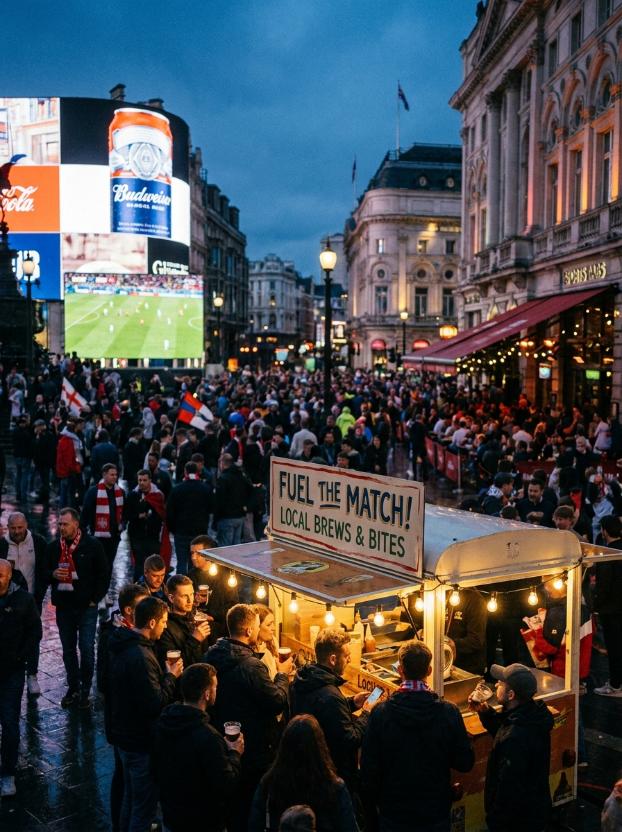
Player likenesses present another opportunity, though one that requires careful navigation. In many jurisdictions, brands can feature players they have individual endorsement deals with, even without FIFA’s blessing. What’s more universally accessible is fan-culture imagery: crowds watching on outdoor screens, living rooms draped in scarves, face paint, the rituals of gathering. These images carry enormous emotional weight precisely because they center the viewer’s experience rather than the institution’s.
The most underused tactic visible in spy tool data is real-time creative swapping based on match outcomes. Build two versions of every ad set: a celebration angle and a consolation angle. When a favored team wins, the celebration creative goes live within minutes — “Your team showed up. So should your [product].” When they lose, the consolation version activates — “Rough night. Here’s something that won’t let you down.” This requires pre-built creative variants and trigger-based deployment, but the performance lift is substantial because you’re matching the emotional state of your audience in the moment they’re most engaged.
The thread connecting all of these patterns is the same: the best ambush creative doesn’t try to borrow FIFA’s authority. It borrows the fan’s identity. As OOH Today reported, understanding where cultural affinity, community behavior, and physical movement intersect in real time is what separates campaigns that drive action from those that merely accumulate impressions. You don’t need a FIFA badge to win during the World Cup. You need creative that proves you understand what it feels like to care about the outcome.
Timing Is the Weapon — How to Build a Real-Time Campaign Calendar from Spy Data
Most performance marketers build their World Cup campaign calendars the same way: they pull the fixture list, highlight the marquee matches, front-load budget into opening day and the final, and call it a plan. It’s neat, logical, and almost guaranteed to leave money on the table — because the tournament doesn’t behave like a single tentpole event. As one industry analysis put it, attention is not concentrated into one day — it evolves over multiple weeks as storylines shift, teams advance, and audience momentum changes. The group-stage upset that sends a host nation home early, the underdog run that captivates an entire continent, the controversial VAR decision that dominates social media for 72 hours — these inflection points reshape where audience attention clusters, and they can’t be predicted from a bracket.
This is where competitor intelligence transforms from a nice-to-have into a real-time navigation system. Instead of guessing which moments will matter, use tools like Anstrex to monitor competitor ad volume as the tournament unfolds. A sudden surge of new creatives targeting a specific GEO — say, a wave of sports-betting ads flooding native networks in a Latin American market after a dramatic group-stage result — tells you that moment is heating up and audience engagement is spiking in that region. That’s your signal to deploy pre-built creative assets into the same attention corridor before CPMs fully inflate. Conversely, watch for competitors pulling campaigns or pausing spend in specific verticals. That pullback often signals either saturated CPMs that have made the economics untenable or poor creative performance, both of which create openings. When a well-funded competitor retreats, inventory gets cheaper and less cluttered — exactly the conditions where a scrappy, culturally fluent campaign can punch above its weight.
The tactical advantage compounds when you layer tournament-driven spy data against the broader sporting calendar. SilverPush’s analysis of the stacked Summer of Sports 2026 calendar — which includes Wimbledon, the Tour de France, and Formula 1 races running concurrently with the World Cup — reveals overlap windows that most World Cup advertisers ignore. During the Wimbledon final or a dramatic Tour de France mountain stage, sports-adjacent audiences remain highly engaged, but the firehose of World Cup ad spend temporarily redirects attention and budgets. These shoulder moments create brief CPM dips in World Cup-related inventory as the biggest spenders chase whichever event is trending hardest. Your calendar should map these overlaps explicitly: when a major F1 qualifying session or Wimbledon semifinal pulls competitor budgets sideways, that’s your window to buy World Cup–adjacent placements at a discount.
Building this kind of dynamic calendar requires the operational flexibility that traditional planning frameworks simply don’t support. As OOH Today emphasizes, campaigns need enough structure to scale globally while maintaining enough flexibility to adapt locally as the tournament evolves. In practical terms, that means pre-producing modular creative variants before kickoff — multiple headline angles, geo-specific hooks, various emotional registers from celebratory to consolation — so you can deploy the right asset within hours of a storyline breaking, not days. It means setting aside a meaningful portion of your budget as a flexible reserve rather than committing everything to pre-scheduled flight dates. And it means benchmarking your own performance against industry-wide data in real time, so you can distinguish between a creative that’s underperforming and a market that’s temporarily overheated.
The brands that win the World Cup without a sponsor budget won’t be the ones with the best pre-tournament plan. They’ll be the ones running a live intelligence operation — reading competitor signals, exploiting calendar overlaps, and redeploying spend toward wherever cultural momentum is actually building right now.
From Intelligence to Execution — Building Your 72-Hour Ambush Sprint
Intelligence without execution is just trivia. Everything you’ve gathered — the competitor creative patterns, the timing gaps, the audience whitespace — has a shelf life measured in hours once the tournament begins. The question is how to compress all of that analysis into a deployable sprint that can go live before the opening whistle on June 11 and adapt in real time once the matches start.
The framework below is built around a 72-hour pre-tournament window, the critical period when sponsor campaigns are already saturating social feeds but most non-sponsors are still finalizing approvals. Moving fast here is the entire advantage.
Hours 0–24: Lock the Brief and Build the Asset Bank
Start by consolidating your competitive intelligence into a single decision document — not a report, a brief. It should answer three questions: What emotional territory are the major sponsors occupying? Where is the creative whitespace they’ve left exposed? And which of your brand’s existing assets can be repurposed to fill it? If your competitor audit revealed that official sponsors are clustering around themes like national pride and athletic heroism, your brief should explicitly stake out adjacent emotional ground: humor, irreverence, underdog narratives, or the communal chaos of watch parties.
Simultaneously, build a modular asset bank. This means creating five to eight creative templates — static, short-form video, and native ad formats — that can be updated with real-time match references within minutes. The key word is modular: interchangeable headlines, swappable imagery, and pre-approved copy variations that legal has already cleared. As Brax’s performance tracking guidance emphasizes, setting clear and measurable goals before launch is essential because once the campaign is live, you need to know immediately which KPIs define success and which creative variants to kill.
Hours 24–48: Stage Distribution and Activate Contextual Targeting
With assets ready, the next 24 hours are about staging distribution across every channel you plan to use. Pre-load campaigns in your native ad platforms, queue social posts with placeholder hooks, and configure your contextual targeting parameters. This is where the intelligence work from previous sections pays off directly. Contextual engines can align your ads with live World Cup content the moment it publishes, and as SilverPush has documented, the ability to act on real-time signals rather than waiting for post-hoc analysis is where non-sponsors build their sharpest advantage over slow-moving official partners.
Also during this window: finalize your blocklist exceptions. Remember that overly broad keyword blocking can keep your ads off exactly the World Cup content you’re trying to ride — match recaps, post-game analysis, goal highlights — simply because the language of football overlaps with terms flagged by blunt brand safety tools, a problem Newsworks CEO Jo Allan called out as an outdated barrier standing between advertisers and the audiences they want to reach.
Hours 48–72: War Room Protocols and First-Response Triggers
The final day before kickoff is about people, not platforms. Assign specific team members to monitor live match feeds, social sentiment, and competitor activity in rotating shifts. Define your first-response triggers: the scenarios — a shocking upset, a viral referee decision, a breakout player moment — that automatically greenlight pre-built creative templates for rapid deployment. Establish a maximum approval loop of two people and 30 minutes. Anything longer and you’ve already lost the moment to a faster competitor.
This 72-hour sprint isn’t about perfection. It’s about being staged, approved, and ready to move while your competitors are still circulating decks for sign-off.
