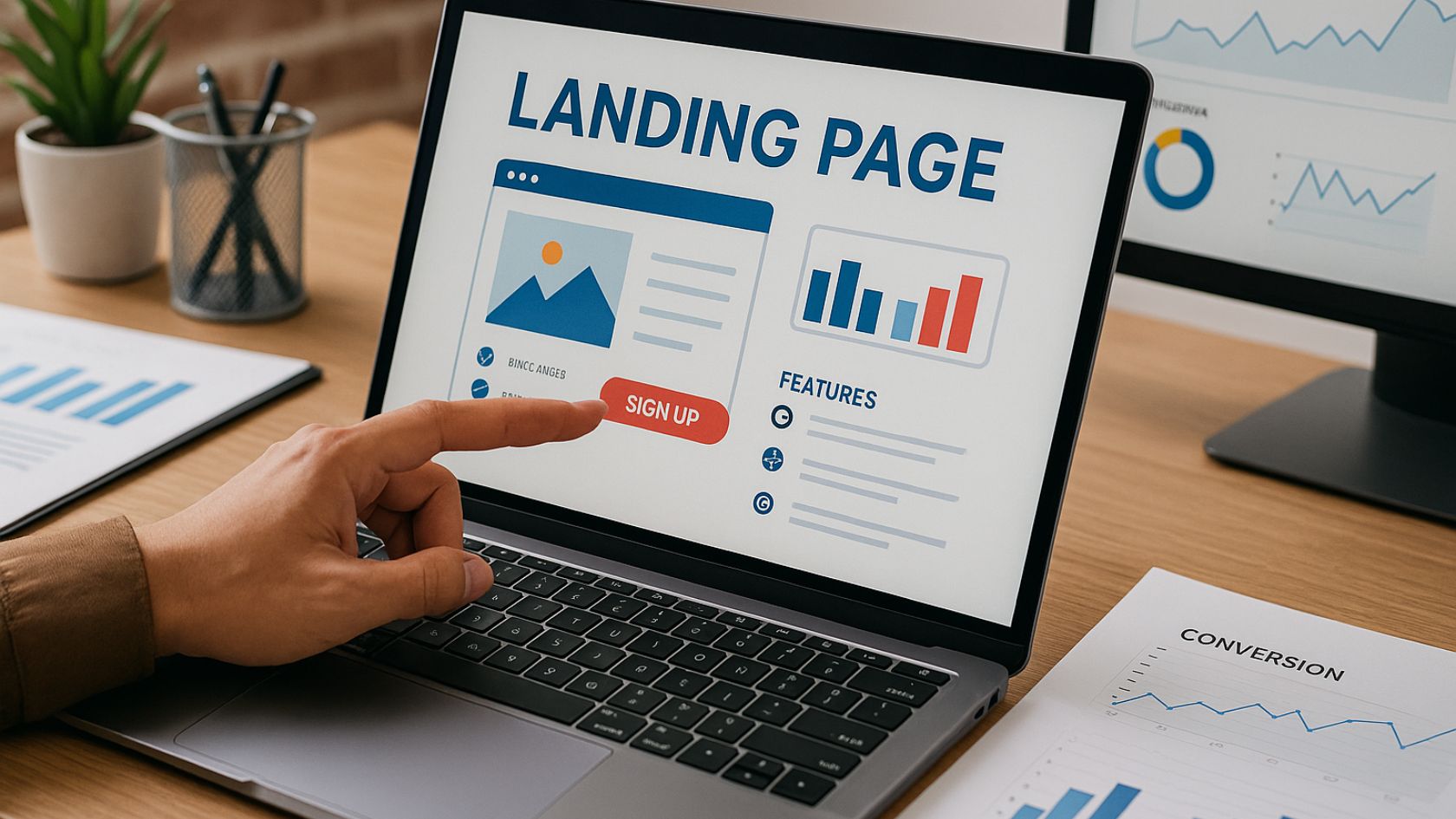
Landing Page Best Practices: A Complete Guide to Higher Conversions

Landing page best practices are the backbone of predictable conversion gains because they align user intent, persuasive messaging, and frictionless UX to help visitors take the exact action you want—be it purchasing, subscribing, or booking a demo.
Before you change a pixel, clarify the single conversion goal and the specific audience segment you are serving. The most successful pages do less, better: one core message, one primary call to action, and one primary path. If you need multiple CTAs, define a primary and secondary hierarchy and make the visual weight unmistakable. For a useful primer that consolidates foundational landing page best practices, review established checklists and then adapt them to your product, funnel stage, and traffic sources.
Know Your Goal and Audience
Every element on the page should fight for its place by proving it serves the goal. Start by writing a one-line promise that captures the outcome your visitor wants in their own words. If your traffic is cold, lead with the problem and desired future state; if it’s warm or branded, lead with the solution, proof, and next step. Map the top three objections your visitors have, then place counter-evidence (proof points, FAQs, microcopy) adjacent to the section where the objection naturally arises.
Traffic source matters more than most teams realize. A user clicking from social often needs context and category education, while a search visitor may be ready for specifics and comparison. If your channel mix is heavy on short-form video, mirror that momentum with concise, scannable blocks and a strong visual hierarchy. For inspiration on channel-to-landing alignment, study this kind of data-driven playbook and translate those audience insights into headline angles, creative sequencing, and offer structure on the page.
Craft High-Converting Copy
Copy is the design of language. Headlines should promise a concrete benefit, not a vague claim. Subheads should de-risk the promise by adding specificity or proof. Body copy should follow a logical path: problem, outcome, solution, proof, action. Use verbs that imply momentum—start, unlock, claim, see—rather than static descriptors. Replace feature-first phrasing with outcome-first phrasing, then backfill features as credible enablers of that outcome.
- Start with outcomes: “Cut onboarding time by 52%,” then support with features that make it plausible.
- Front-load numbers and nouns; bury adjectives. “3x faster approvals” beats “incredibly fast approvals.”
- Use microcopy to remove doubt near form fields, pricing toggles, and CTAs (e.g., “No credit card required”).
- Mirror the exact words users type and say—pull from reviews, support tickets, and sales calls.
Design and Visual Hierarchy
Great design clarifies priority. Make the primary CTA visually dominant through color contrast, whitespace, and placement. Keep the hero section focused: a clear headline, a supporting subhead, one standout visual, and a single primary CTA. Use section-level hierarchy: headline, proof, CTA—repeat. If you include illustrations or product shots, show transformations or outcomes (a before/after chart, an in-product metric climbing) rather than ornamental graphics. Consistent spacing and typography rhythm help users scan and reduce cognitive load.
- Use a 4–8px spacing scale and keep section paddings consistent so the page feels intentional.
- Limit your color palette and reserve the highest-contrast color for the primary CTA only.
- Ensure links are visually distinct with both color and an affordance like underline for accessibility.
Forms, CTAs, and Friction
Ask for only what you need now. Every additional field reduces conversion, so tie each field to a specific follow-up use case. Use progressive profiling when possible. For CTAs, make the copy action-specific and outcome-led. “Get my custom quote” performs better than “Submit.” Add low-friction alternatives like “Continue with Google” if account creation is required. Pair your primary CTA with a clarifying micro-benefit (“Free for 14 days,” “Cancel anytime,” “Takes 2 minutes”).
Trust and Social Proof
Trust compounds. Use logos of recognizable customers, quantified outcomes in testimonials, star ratings from third-party sites, and founder or expert quotes. Specificity sells: “Saved 14 engineer-hours per week” is stronger than “Huge time-saver.” Where possible, link to source material or case studies. Place trust signals near friction points: next to pricing, beneath forms, and near CTAs. Rotate proof types to avoid banner blindness: logos, quotes, stats, badges, media mentions, and screenshots.
Performance and Technical SEO
Speed is a conversion feature. Compress images, lazy-load below-the-fold assets, and avoid blocking scripts in the critical path. Keep HTML semantics clean with one h1, logical h2/h3 structure, descriptive alt text, and concise title/description tags. Use descriptive, human-readable URLs. Implement canonical tags for variants and ensure your page is mobile-first; most paid traffic lands on mobile devices. Add structured data where relevant (Product, FAQ) to improve SERP presentation and click-through rates.
- Target a Largest Contentful Paint under 2.5s and a Total Blocking Time under 200ms.
- Ship only the JavaScript you need; inline critical CSS to speed first render.
- Preload hero images and system fonts; defer non-critical scripts.
Analytics and Experimentation
Instrument before you iterate. Track views of key sections, scroll depth, click maps, and form interactions. Define success metrics (CVR, lead quality, pipeline impact) and set minimum sample sizes for tests. Start with high-impact variables: headline, hero visual, primary CTA copy/placement, offer framing, and form length. Document hypotheses and decisions so learning compounds even when a test is inconclusive. When possible, segment results by device, traffic source, and audience to spot hidden wins or losses.
Prioritization Framework
Use a simple ICE or PXL framework to rank ideas: estimate Impact, Confidence, and Effort, then pick the highest total score. Queue a cadence—weekly for copy and creative, monthly for layout refactors. Bundle small “quality-of-life” fixes (alignment, microcopy, spacing) so they ship quickly without derailing larger experiments. Over time, build a component library for repeatable hero patterns, proof blocks, and FAQs to accelerate iteration while maintaining consistency.
Common Pitfalls to Avoid
Three patterns routinely suppress conversions. First, mixed messages: when the headline, visuals, and CTA point to different outcomes, visitors hesitate. Second, weak proof: generic claims without numbers or recognizable brands erode trust. Third, leaky forms: excessive fields, unclear error states, or mobile-hostile inputs create friction. Fix these by consolidating your message, turning claims into quantified proof, and refactoring the form with clear validation, mobile-friendly inputs, and obvious next steps.
Conclusion
Mastering landing page best practices is less about trends and more about disciplined execution: a crisp promise, user-centered design, credible proof, low friction, and a steady testing cadence. Keep sharpening your offer, evolve your creative to match channel intent, and relentlessly remove friction. If competitive research informs your creative angles, consider augmenting your workflow with a native ad intelligence tool to spot messaging patterns and proof assets that resonate in your niche. Do the simple things thoroughly and the sophisticated things only when the basics are airtight—your conversion curve will thank you.
