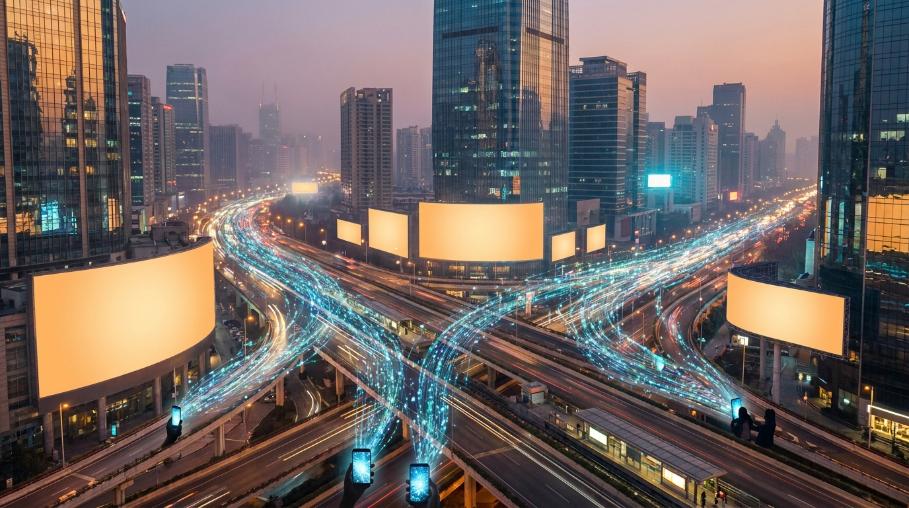
What OOH Advertising’s Hiring Surge Tells Digital Performance Marketers About Where Ad Budgets Are Shifting
The Billion-Dollar Billboard Boom You Can’t Afford to Ignore

If you spend your days inside Meta Ads Manager or obsessing over Google’s latest auction dynamics, it’s easy to treat billboards as relics — the advertising equivalent of fax machines. That instinct is wrong, and the numbers are now too loud to wave away.
Out-of-home advertising just posted its twentieth consecutive quarter of growth, with Q1 2026 revenue reaching a record $2.12 billion. That’s not a post-pandemic bounce. It’s not a seasonal anomaly. Twenty straight quarters means the upward trajectory stretches back to mid-2021, surviving iOS 14.5 privacy shocks, a volatile macro economy, and the very AI disruption that was supposed to make physical media obsolete. Meanwhile, U.S. OOH ad revenue for the full year of 2025 hit a record $9.46 billion — a figure that, as AdQuick noted, represents an industry that is somehow “both booming and underperforming” relative to its share of total media spend.
The digital formats within OOH are accelerating the fastest. Digital out-of-home grew 12.9 percent year-over-year in Q1 2026 and now accounts for 36 percent of total OOH revenue. Digital transit jumped 25 percent. Digital street furniture rose 21.5 percent. Every single DOOH category posted gains, with double-digit growth across nearly every format. And this isn’t just a story about screens replacing static vinyl — printed OOH itself grew 4.1 percent, a reminder that the underlying medium has broad-based demand, not just a tech-driven niche.
What makes this especially relevant for performance marketers is who is fueling the surge. Technology advertisers — the same companies buying the search and social inventory you’re bidding against — increased their OOH spending by a staggering 139 percent in Q1, as OAAA data shows. AI brands in particular are pouring money into physical media, betting that real-world visibility drives the kind of trust and top-of-funnel awareness that even the most precisely targeted programmatic display cannot replicate. When your competitor’s AI product is on a highway billboard, it’s not doing brand vanity work — it’s priming the search queries and branded traffic you’ll see spike three weeks later.
The intent signal becomes even clearer when you look at where marketer budgets are headed. Research from the OAAA and Winterberry Group found that eighty-six percent of marketers plan to increase their OOH investment over the next two years, while ninety-eight percent already view OOH as a core or supporting component of their connected commerce strategies. These aren’t fringe brands dabbling in something experimental. These are the same advertisers crowding your auction, inflating your CPMs, and fragmenting the digital attention you depend on.
Here’s the reframe that matters: OOH’s growth is not a competitive threat to your digital campaigns. It’s a leading indicator. When a major brand commits millions to billboards, transit wraps, and digital place-based screens in a specific market, they’re generating awareness that will inevitably translate into search volume, direct traffic, and social engagement — all channels where a savvy performance marketer can capture downstream demand. Ignoring the OOH boom means ignoring the upstream source of the very intent signals your campaigns are built to convert. And twenty quarters of consecutive growth suggests the stream is becoming a river.
Follow the Money — Which Brands and Verticals Are Pouring Into OOH (and Why That’s Your Target List)
Every quarter, the Out of Home Advertising Association of America publishes a leaderboard of the biggest OOH spenders in the country. Most performance marketers have never glanced at it. That’s a mistake — because this data is essentially a free competitive intelligence report telling you exactly which brands are about to flood the top of the funnel with awareness dollars that will inevitably create downstream demand someone needs to capture.
The Q1 2026 numbers make the signal unmistakable. Spending from computers, software, and internet services advertisers surged 139% year over year, making technology the single fastest-growing OOH category by a wide margin. Financial services followed with a 29% increase. Nine of the top ten product industries grew their OOH investment, but those two verticals are pulling away from the pack in a way that should sharpen every affiliate and performance marketer’s targeting strategy.
Look at the names driving that tech surge. Three AI companies — Genspark, OpenAI, and Lambda — were among the quarter’s newest and fastest-growing OOH advertisers. These aren’t legacy brands refreshing a stale campaign. They are companies in an existential race for consumer mindshare, and they’re choosing massive, unskippable formats to plant their flags. When OpenAI wallpapers a transit station or Lambda takes over a highway billboard corridor, they’re telling the market: We are spending aggressively to make sure millions of people know our name. That awareness push doesn’t end at the billboard. It cascades into search queries, social conversations, app store browsing, and comparison shopping — all territory where a well-positioned performance campaign can intercept freshly created demand.
The roster gets even more interesting when you zoom out. Among the top 30 OOH spenders, twelve were technology or direct-to-consumer brands, including Apple, DoorDash, Amazon, and Uber. Meanwhile, more than twenty of the top 100 advertisers more than doubled their OOH budgets — a list that features eBay, Capital One, Brex, and Citi alongside consumer names like Pepsi and Grocery Outlet. When a fintech like Brex doubles its billboard spend, it’s signaling a major awareness push aimed at startup founders and finance teams — exactly the audience that will later search for “best corporate card for startups” or click on a comparison article in their LinkedIn feed.
This is where the opportunity crystallizes for digital performance marketers. OOH operates in a fundamentally different measurement paradigm — it models who probably walked or drove past a sign rather than tracking who clicked. That means OOH advertisers generate enormous demand they can’t directly attribute or retarget from the billboard itself. Someone else has to catch that demand when it reaches a screen. That someone should be you.
Treat the OAAA’s quarterly spending report as a brand-by-brand hit list. If Genspark just appeared in the top 100, there is a window — possibly a narrow one — to build content, bid on adjacent keywords, and launch push or native campaigns around the curiosity their billboards are generating before every other performance marketer catches on. The same logic applies to every vertical accelerating its OOH investment: the brands spending millions on awareness are effectively subsidizing your cost-per-acquisition if you’re fast enough to position downstream. Most performance marketers are watching CPMs inside their own dashboards. The smarter ones are watching the billboard leaderboard too.
The “Halo Effect” — How OOH Spending Creates a Digital Intent Wave You Can Ride
The billboard on the highway doesn’t just register in your peripheral vision and vanish. It follows you home — into your browser, your search bar, your late-night scrolling. This is the halo effect, and the data backing it is now robust enough that ignoring it qualifies as strategic malpractice for anyone running digital performance campaigns.
Start with the topline: research cited by the OAAA found that OOH delivers twice the performance lift of television, a medium that still commands the lion’s share of brand budgets. That stat alone should reframe how digital marketers think about the upstream forces driving their downstream conversions. But the behavioral specifics are where the real opportunity lives. Eighty percent of consumers say they are likely to take action after seeing a creative, visually engaging OOH ad. Nearly half search for the advertiser. Almost a quarter make a purchase. These aren’t hypothetical survey responses about what people might do — they’re measured outcomes from real campaigns seen by real people, as AdQuick emphasizes, “people with bodies, in cities, doing things. Not bots.”
Now layer in the neurological dimension. Digital out-of-home formats drive 3.2 times more neurological response and memory activity than traditional static placements — a finding rooted in neuroscience research, not self-reported recall. That heightened cognitive imprint explains why the search behavior materializes so reliably. When a brand’s creative hits harder at the neural level, the latent intent doesn’t just linger — it converts into a query.
Here’s the part most performance marketers miss: you don’t have to be the brand on the billboard to benefit from this intent wave.
When a major fintech company blankets a metro area with OOH placements, it isn’t just building awareness for itself. It’s priming an entire audience to think about the category. Consumers who search for that brand also encounter competitors in the SERP. They see comparison articles, alternative product ads, and brand-adjacent keyword campaigns. The spillover traffic — branded searches, category queries, “best alternative to X” long-tail terms — becomes harvestable inventory for any digital advertiser paying attention.
This is especially potent for native and push campaigns. Native ads thrive on contextual relevance, and nothing creates context like a fifty-foot billboard that half a million commuters drive past every day. If you’re running native placements in the same DMA where a competitor just launched an OOH blitz, you can align your creatives with the category awareness that billboard is generating. Push notification campaigns, similarly, can target users in those geographies who’ve recently demonstrated intent through search or site visits triggered by OOH exposure.
The mechanics are straightforward. Cross-reference the OAAA’s quarterly spending reports with your campaign targeting. Identify which brands are increasing OOH investment in your verticals and geographies. Build keyword clusters around those brands and their category terms. Layer geo-targeting onto your native and push buys to match the DMAs where those OOH campaigns are running. The combination of DOOH’s growing precision — enabled by the same geofencing, tracking, and retargeting capabilities that power online display — and your existing digital infrastructure creates a feedback loop that neither channel could produce alone.
The halo effect isn’t charity. It’s physics. When billions of dollars in OOH spending push consumers toward their screens, that intent energy doesn’t belong exclusively to the advertiser who paid for the billboard. It belongs to whoever is smart enough to be waiting on the other side of the search bar.
Predictive Intelligence — Using OOH Signals to Time Your Digital Campaigns
The OOH industry is no longer content to tell you what happened last quarter. It is building machinery to tell you what is about to happen next — and if you run digital performance campaigns, this shift should change how you plan, bid, and deploy.
Consider what’s emerging under the surface of the OOH ecosystem. When Trillboards partnered with hellOOH, the announcement wasn’t about buying more billboard inventory. It was about layering predictive intelligence on top of campaign data — a fundamentally different ambition. hellOOH’s architecture is built around four core intelligence layers, including what it calls a Verified Campaign Intelligence Graph that maps real OOH campaign activity over time, tracking advertiser-level attribution, format-level deployment, and historical spending patterns to create a longitudinal model of how demand behaves. On top of that sits a Predictive Demand and Market Intelligence Engine designed to identify likely repeat advertisers, emerging category-level demand shifts, geographic expansion signals, and early buying indicators before the broader market sees them.
Read that list again, but this time through the eyes of a digital media buyer. Every one of those signals — which brands are spending, in which geographies, through which agencies, and in which formats — is directional intelligence about where top-of-funnel awareness dollars are about to land. And as we established in the previous section, awareness dollars create intent waves. The question for performance marketers isn’t whether these signals matter. It’s whether you’re capturing them fast enough to position your native, push, and paid social buys in the path of the downstream search and engagement surge.
The OOH sector’s own leaders frame this as a shift from backward-looking reporting to predictive market modeling — moving from “what happened?” to “what is likely to happen next?” That framing should sound familiar to anyone who has built lookalike audiences or predictive LTV models in digital. The methodology is the same; only the input data is different.
So how do you build your own version of this intelligence loop? Start with the publicly available data. The OAAA releases quarterly revenue breakdowns by format and advertiser category. The most recent report showed technology advertisers surging 139 percent in Q1 2026, with digital transit up 25 percent and digital street furniture up 21.5 percent. That’s not trivia — it’s a geographic and category-level buying signal. When tech and AI brands are pouring money into transit and street furniture in specific metros, those metros are about to experience a measurable lift in branded search volume, app-store browsing, and category-level discovery behavior. Your retargeting pools in those DMAs will swell. Your CPCs on adjacent keywords will shift. If you’re not watching, you’re reacting to price changes you don’t understand.
Meanwhile, platforms like AdQuick are functioning as universal adapters that increasingly make OOH campaign data legible to the programmatic ecosystem, accelerating the convergence between physical media buying and the digital infrastructure performance marketers already inhabit. As OOH buying becomes more programmatic and more transparent, the intelligence gap between OOH insiders and digital outsiders is closing — but only for those who are paying attention.
The actionable framework is simple: monitor OOH category spending reports quarterly, track which brands are launching or expanding outdoor campaigns in specific geographies, and pre-position your digital campaigns in those markets two to four weeks after OOH flights begin. You’re not guessing. You’re reading the demand signal that the OOH industry itself is now sophisticated enough to quantify — and then deploying against the intent it creates.
The Playbook — How to Spy on OOH Campaigns and Build a Spillover Capture Strategy
Everything you need to execute this strategy is already public. The barrier is not access — it is the absence of a systematic process for harvesting signals that OOH advertisers broadcast, quite literally, on the sides of buildings and buses.
Step one: Monitor the scoreboard. The OAAA publishes top-100 OOH advertiser rankings every quarter, and Q1 2026 data showed technology advertisers surging as OOH revenue hit a record $2.12 billion, with tech spending climbing 139 percent year-over-year. That single data point tells you which verticals are flooding physical media with awareness spend — and therefore which brands’ audiences are about to spike in digital search, social engagement, and retargetable intent. Bookmark the OAAA’s quarterly releases. When a category like financial services or AI infrastructure jumps ten spots in the rankings, that is your cue to pre-build campaigns targeting adjacent keywords and audience segments before the spillover wave hits.
Step two: Close the intelligence loop. Quarterly rankings tell you who is spending, but platforms building what hellOOH calls a Verified Campaign Intelligence Graph go further — they map which agencies are buying, in which formats, and across which geographies. Use competitive intelligence tools like AdSpy, Anstrex, or PowerAdSpy to cross-reference those same advertisers’ native and push creatives. The goal is to identify the exact messaging arc a brand is deploying: what emotional register the billboard hits, what CTA the digital display follows up with. Your job is to insert yourself into the gap between the two.
Step three: Geo-match your campaigns to OOH saturation zones. Transit was the fastest-growing OOH format in Q1 2026, surging 18 percent over the prior year, and digital transit grew 25 percent. That growth concentrates in specific urban corridors — subway systems, commuter rail networks, airport terminals. When you know a brand is saturating the Chicago L or the New York subway, you can geo-fence your native and push campaigns to those same DMAs, targeting the exact population that just walked past a forty-foot brand-awareness creative. The physical world does the priming. Your digital campaign captures the intent.
Step four: Align your messaging deliberately. If the billboard running in a transit hub is aspirational — lifestyle imagery, category-level emotional appeal — your digital creative should be functional: pricing, comparison, product-specific hooks. If the OOH creative is promotional, your digital angle can be educational or trust-building. The point is to complement, not echo. A consumer who has already absorbed a brand-awareness message does not need to see it again in a 300×250 banner; they need the next logical step toward conversion.
Step five: Time your launches to OOH flight schedules. OOH campaigns typically run in four- to twelve-week flights, and you can identify start dates by simply photographing or cataloging when new creatives appear on known inventory. As AdQuick has documented, the industry now extends through nineteen — and as of Q1 2026, twenty — consecutive quarters of growth, which means flight schedules are becoming more predictable and more densely packed. Synchronize your digital campaign launches with the first week of a new OOH flight, when brand recall is ramping fastest and search volume has not yet peaked.
None of this requires partnerships, API access, or insider relationships. It requires a spreadsheet, a quarterly calendar, a competitive intelligence subscription, and the discipline to treat physical advertising as the upstream signal it has always been.
